Gurmukhi and Shahmukhi are two writing systems used for Punjabi. Gurmukhi is written from left to right and is widely used in Indian Punjab; Shahmukhi is written from right to left and is used for Punjabi in Pakistan. Choose the script that matches what you want to read and who you want to communicate with, rather than looking for one universally better option. [1] [2]
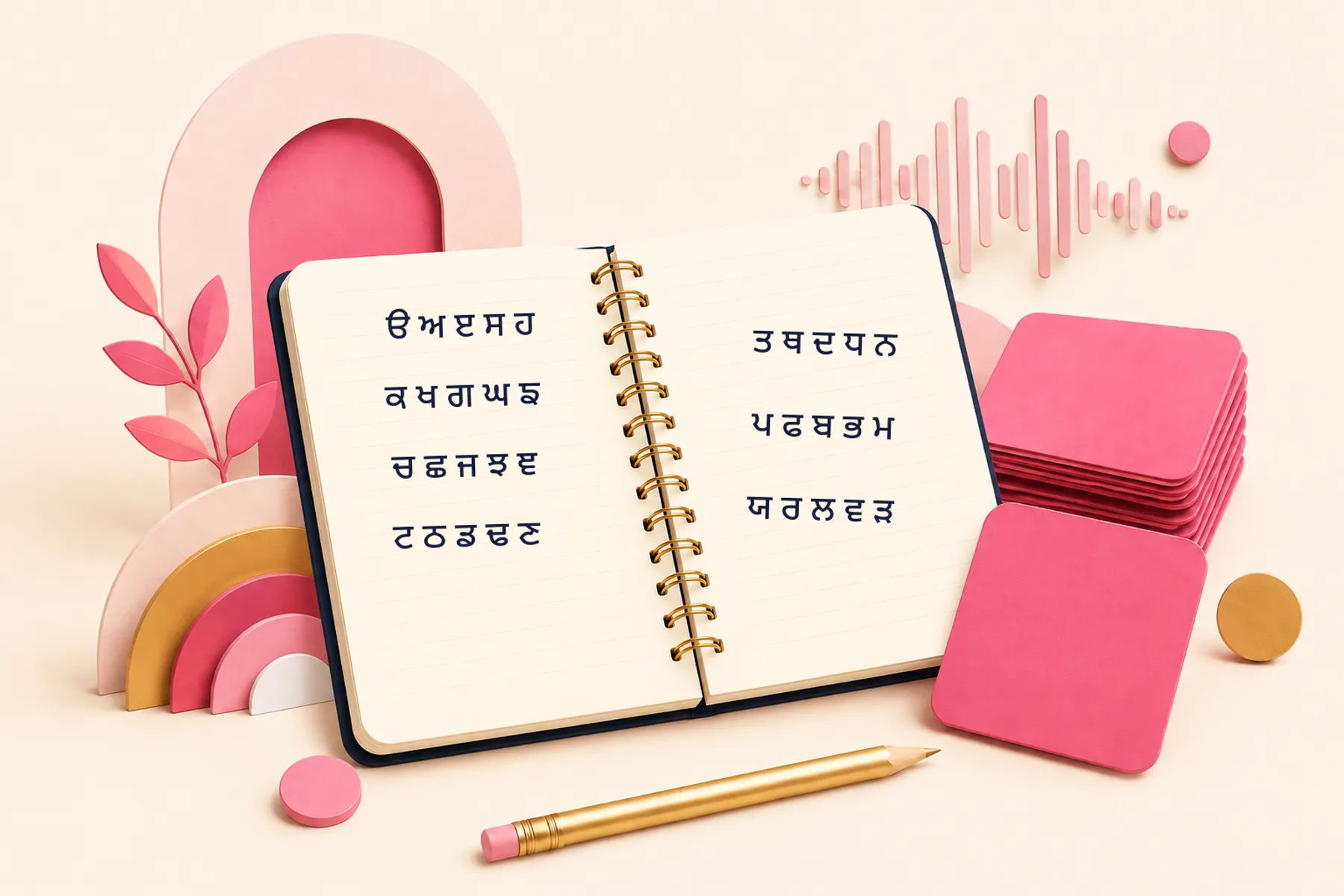
A learner can reach this decision from several directions. You might understand relatives but not their messages, recognise Urdu letters but be new to Punjabi, or want to read a particular book. Another learner may simply want to hold a conversation and feel worried that choosing the wrong alphabet will set them back. These are different goals, so they do not need identical starting plans.
This comparison helps you choose a practical next step. It does not teach either alphabet in full, assign a script to your identity or promise a fixed learning time. Start with an actual reading or communication task, then use the decision worksheet below to choose one script, a carefully organised combination, or a spoken-first approach.
One language, two writing systems
A language and its script are not the same thing. Punjabi is the language; Gurmukhi and Shahmukhi are ways of writing it. Changing the writing does not automatically change a Punjabi sentence into another language. The University of Pennsylvania describes Punjabi as being written in Gurmukhi in India and Shahmukhi in Pakistan. These are useful broad patterns, not instructions about what any individual must learn. [1]
Keep three questions separate in your study notes: which spoken Punjabi do I want to understand, which script appears in my materials, and what kind of text am I reading? A poem, a family message and a beginner lesson can ask different things of you even when they use the same script. For the spoken-variety question, use the separate guide to choosing a Punjabi variety.
| Feature | Gurmukhi | Shahmukhi |
|---|---|---|
| Reading direction | Left to right | Right to left |
| Broad regional use | Punjabi writing in Indian Punjab and related communities | Punjabi writing in Pakistan and related communities |
| What the beginner notices | Letters and vowel signs positioned around them | Letter joining, changing shapes and right-to-left reading |
| Useful first task | Read a short familiar Punjabi phrase | Read a short familiar Punjabi phrase |
| Choice should follow | The texts and people relevant to your goal | The texts and people relevant to your goal |
The geographical and writing-system distinctions come from university and script documentation. The suggested tasks are a learning framework for this guide, not a published test of which script is easier. [1] [2] [3]
What should you know about Gurmukhi?
Gurmukhi is read from left to right. Its consonant letters work with vowel signs, and there is no English-style distinction between uppercase and lowercase letters. Punjabi University's introductory teaching materials explain these features and caution that Roman equivalents are only approximate pronunciation guides. [2]
For a first session, choose a word whose meaning and spoken form you already know. Look at it, hear it, trace it and identify one repeated part. Avoid making your first target “recognise every letter in every word”. A small familiar phrase gives you something meaningful to revisit without turning the exercise into a test of memory alone.
Gurmukhi has an important association with Sikh traditions, while also serving everyday Punjabi writing. That association does not mean a learner must belong to a particular community to study it. When a religious or historical text is your goal, identify the exact text and ask what additional language or interpretation support you will need. Script recognition alone does not establish understanding. [4]
The Gurmukhi alphabet guide is the practical next step for letter learning. Keep the present article for the decision itself, rather than trying to cover the entire alphabet before you have chosen a useful purpose for reading.
What should you know about Shahmukhi?
Shahmukhi belongs to the Arabic-script writing tradition used for Punjabi in Pakistan. Right-to-left reading and contextual letter shapes are important things to notice. In Arabic-script text, letters can join differently according to their position; the appearance of a printed word is therefore not simply a row of isolated alphabet-chart shapes. [1] [3]
A learner who reads Urdu can start by checking which shapes feel familiar and which Punjabi words remain unfamiliar. Do not skip that second check. Familiar letters can make a page look accessible before you understand its vocabulary, pronunciation or meaning. Ask a fluent reader to help you separate a reading problem from a Punjabi-language problem.
For a learner new to right-to-left writing, begin with a short line, a clear font and a spoken model. Follow the direction with your finger, locate the spaces, then compare a repeated word in two sentences. When practising on a phone, check that the keyboard and text direction are suitable before assuming an odd display is your mistake.
Use the Shahmukhi alphabet guide for a separate introduction to letters and joining. You do not need to study both full alphabets to decide which one belongs in your current learning plan.
See the same Punjabi through different writing
The examples below connect a meaning with a learner-friendly Roman spelling and the two scripts. Roman forms help you recognise the examples, but they do not supply every detail of pronunciation. These are deliberately small learning examples, not a word-for-word conversion key for every Punjabi text.
| Meaning | Roman Punjabi | Gurmukhi | Shahmukhi |
|---|---|---|---|
| Punjabi | Punjabi | ਪੰਜਾਬੀ | پنجابی |
| Book | kitaab | ਕਿਤਾਬ | کتاب |
| What is this? | Eh ki hai? | ਇਹ ਕੀ ਹੈ? | ایہہ کی ہے؟ |
Try a simple observation task. Cover the Roman column and locate the word for “book” in each script. Now uncover the meaning and say the word. Finally, explain what helped: a letter shape, a familiar sound, or remembering the position in the table? Only the first two will help when the word moves to a different page.
Do not use this table to judge whether one script is more authentic. Its purpose is to show that a meaning can be approached through different written forms. Your next useful question is which form you are likely to meet again in a book, lesson, message or family activity.
Which script should you choose first?
Collect three examples of what you want to read. They might be messages shared with permission, a book cover and a lesson handout. Identify the script in each and write down why the item matters to you. This creates a decision based on your own materials instead of a vague sense that one route is expected.
| Your immediate goal | A sensible starting choice | What to check first |
|---|---|---|
| Read Punjabi messages from relatives | The script those relatives actually use | Ask for a short sample rather than assuming |
| Use a particular Punjabi book or course | The script in that material | Check vocabulary level as well as letter difficulty |
| Read a specific religious or cultural text | The script in the edition you plan to use | Ask about reading, language and interpretation support |
| Speak during family calls | Spoken-first practice, with a later script checkpoint | Choose a conversation task and a listening model |
| Read across both script traditions | One anchor script, then a planned second track | Decide what you want to read in each |
There is no need to treat your first choice as permanent. Write a review point into your plan: after working through a short set of familiar texts, ask whether your reading goal has changed. If it has, adjust the materials. Changing the next step is different from abandoning everything you have learned.
Can you learn both scripts?
You can choose to study both, but give each track a clear purpose. One practical arrangement is to use a single spoken phrase set and keep separate reading notes for each script. This makes it easier to notice whether you are learning a new writing pattern or struggling with a Punjabi word you did not yet understand.
For example, use one session to recognise three familiar words in Gurmukhi and another to locate those same words in Shahmukhi. In a third session, read a short phrase without the parallel column. Record what you can actually identify. Do not count copying a line or matching its position in a table as independent reading.
Pause the second track when it leaves you without enough time for your main goal. A family-conversation learner may prefer to protect speaking practice; a reader working on a particular text may prioritise that text's script. This is a planning choice, not evidence that the second script is unsuitable for you.
Your script-choice worksheet
Complete four sentences in your notes: “I want to read…”, “The script in that material is…”, “I can already recognise…”, and “My next small task is…”. Be specific enough that someone else could see whether the task was completed. “Recognise my name in this message” is easier to check than “get better at Punjabi”.
Next, choose one short phrase with a checked meaning and a pronunciation model. Read it once with support, cover the support and try again. Note whether the difficulty was the letters, the spoken word or the meaning. That note tells you what help to request instead of treating every hesitation as an alphabet problem.
For a broader sequencing decision, read whether to learn speaking or reading first. To turn your own materials into a focused next step, bring the worksheet to a private online Punjabi lesson with Komal and discuss the script that serves your goal.
For a temporary reading bridge alongside your chosen script, use the Roman Punjabi guide and listening-note worksheet.
Sources and reading notes
Parallel examples use simplified Roman spellings for orientation. They are not a universal transliteration standard, and no separate tutor recording or language-review claim is made.
- University of Pennsylvania: The Punjabi Language, language and broad script use.
- Punjabi University: Introduction to Gurmukhi, direction, letters, vowel signs and approximate Roman equivalents.
- W3C: Arabic and Persian Layout Requirements, general Arabic-script direction and contextual joining, not a Punjabi grammar reference.
- Unicode Standard, Gurmukhi section, script use and structure.