Which Punjabi should you learn? Pakistani, Indian, Majhi and Potohari explained
A family-first guide to choosing the spoken variety and script that match the people you want to understand.
Written and reviewed by Komal B.Published 27 July 2026About 9 minutes
The short answer
Learn the Punjabi spoken by the people you most want to understand. If your goal is family conversation, begin with your family’s town, district and preferred name for their speech. Choose Majhi for a broad central-Punjab base, Potohari when it reflects your home community, and add Gurmukhi or Shahmukhi only if reading matters to your goal.
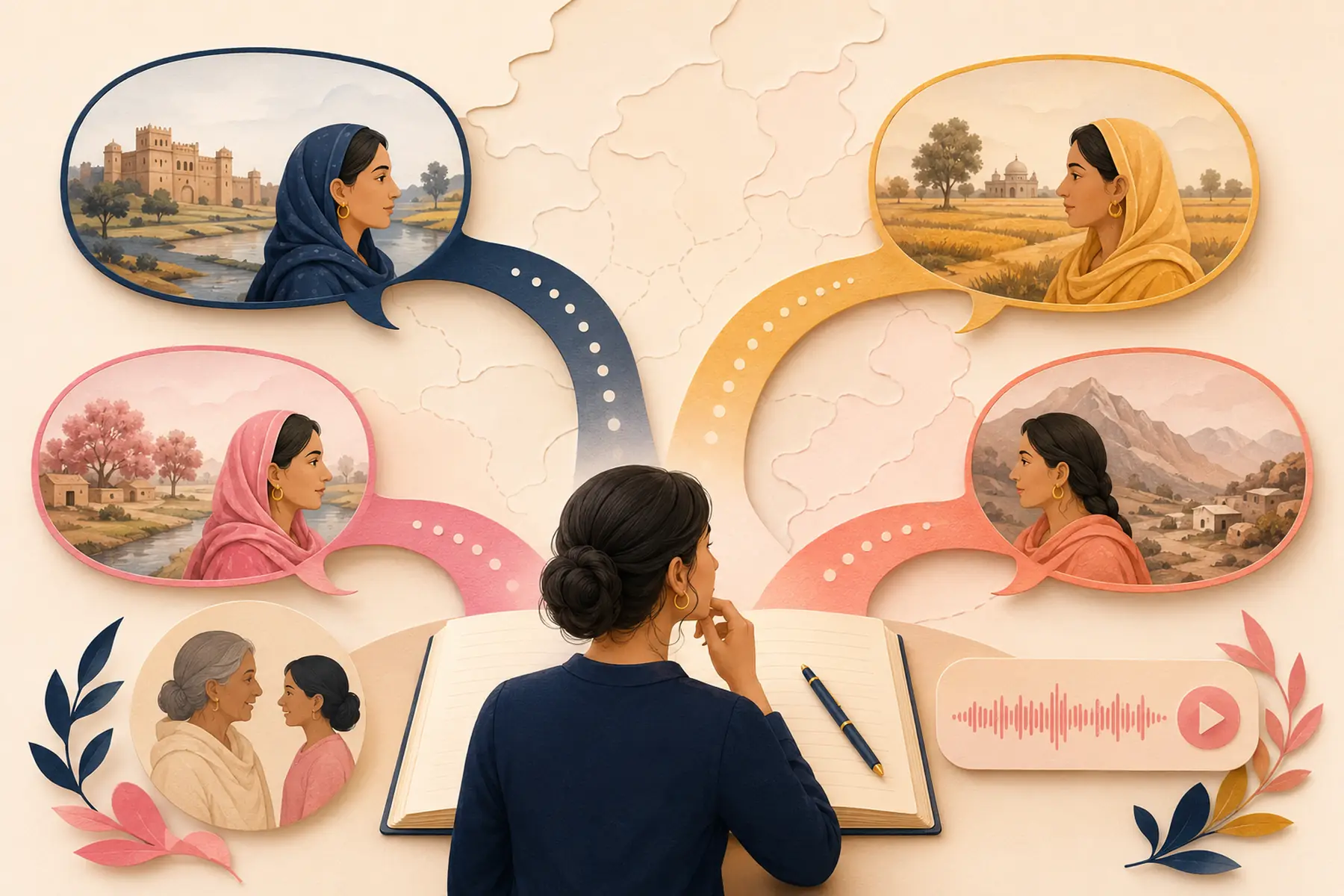
Many beginners ask, “Should I learn Pakistani Punjabi or Indian Punjabi?” That is a sensible starting question, but it is not quite specific enough. Punjabi does not change neatly at a national border. Families on both sides of Punjab use regional varieties, and migration can bring several kinds of Punjabi into one household.
The best choice is therefore not the variety with the biggest label. It is the one that helps you take part in the conversations that matter to you. This guide gives you a practical way to identify that variety without treating one accent, dialect or script as more “real” than another.
Why is there more than one kind of Punjabi?
Punjabi is spoken across a large region and throughout a worldwide diaspora. Like English, Arabic or Spanish, it has developed local vocabulary, sounds, rhythms and grammatical preferences. Two people can both speak Punjabi while using different familiar words or sentence endings.
A dialect or regional variety can involve differences in vocabulary, pronunciation and grammar. An accent mainly describes how speech sounds. In everyday conversation, people may use these terms loosely. Your relatives may say they speak “Punjabi”, name a regional variety such as Majhi or Potohari, or simply identify their speech by their town.
These labels are useful guides, not sealed boxes. Regional speech changes gradually, families move, and people adjust how they speak according to place and company. Classification is especially sensitive around Pahari-Pothwari, where community self-identification and academic labels do not always match. That is why this article uses “variety” where a rigid label would be misleading.
Komal’s learner-first rule: do not begin by asking which Punjabi is the most standard. Begin by asking who you want to speak with, where their Punjabi comes from and what they call it themselves.
What is the difference between Pakistani and Indian Punjabi?
“Pakistani Punjabi” and “Indian Punjabi” are broad, practical labels. They describe national and educational context more than one single dialect on each side.
Pakistani Punjabi
Pakistani Punjabi includes Majhi and several other regional varieties, including Potohari-related speech in northern areas. Urdu and English may influence modern vocabulary. Punjabi is commonly written in Shahmukhi when it is written, although many heritage learners initially focus only on speaking.
Indian Punjabi
Indian Punjabi also includes regional varieties, including Majhi, Doabi and Malwai. Hindi and English may influence modern vocabulary. Gurmukhi is the usual Punjabi script in Indian education, publishing and public life.
Neither label tells you exactly how one family speaks. A family from Lahore and a family from Rawalpindi may both say “Pakistani Punjabi” while sounding noticeably different. Likewise, families from Amritsar, Jalandhar and Ludhiana may all say “Indian Punjabi” but use different local features.
If you only want conversation, you do not have to choose a script before you begin. If you want to read messages, literature, song lyrics or family writing, your context will usually guide the decision: Gurmukhi is widely used for Punjabi in India, while Shahmukhi is widely used for Punjabi in Pakistan. A future script-focused guide can help with that separate choice; this article keeps its focus on spoken variety.
What does Majhi Punjabi mean?
Majhi is associated with the central Majha region, including the Lahore and Amritsar areas. University Punjabi resources commonly describe it as a central or widely taught variety that crosses today’s India–Pakistan border. This cross-border position is important: Majhi is not simply “Indian Punjabi” or “Pakistani Punjabi”.
Majhi can be a useful starting point when you want a broad conversational base, when your family comes from central Punjab, or when no one in the family uses a more specific regional name. It appears frequently in teaching and media, so learning materials can be easier to find.
That does not make Majhi linguistically better than Potohari, Doabi, Malwai or any other variety. It only means it may serve as a practical shared base in certain contexts. If your grandparents use Potohari at home, replacing their speech with Majhi would move you away from your real goal.
Where does Potohari fit?
Potohari, also written Pothwari, is associated with the Pothohar region of northern Punjab, including areas around Rawalpindi and neighbouring districts. Closely related speech is also used across parts of the wider Pahari-Pothwari area, including communities connected with Jhelum and Mirpur.
You may see Potohari described as a Punjabi dialect, as part of a Pahari-Pothwari language complex, or under other academic classifications. Community labels matter here. Oxford’s Creative Multilingualism project notes that speakers’ own names for Pahari-Pothwari do not always match labels applied from outside the community. For a learner, the respectful response is simple: ask your family what they call their speech and listen to how they use that name.
Choose Potohari-focused learning when the people you want to understand use it naturally, especially if family connection is your main motivation. You may still learn broader Punjabi alongside it. The aim is not to isolate varieties but to make sure the forms you practise actually prepare you for your family’s voices.
If you are ready to hear how the variety works in everyday exchanges, use the separate guide to 10 Potohari sentences for beginners. That page owns the practical phrase examples; this one stays focused on choosing the right learning path.
Not sure what your family speaks?
Komal can listen to your family context, preferred region and learning goal, then suggest a variety-matched starting plan without forcing your speech into one generic course.
A town name and a short voice note can tell you more than a broad national label. Ask one or two relatives these questions and write down their answers.
Where did our Punjabi-speaking relatives grow up? Ask for the town or village, district and nearest large city rather than only “Pakistan” or “India”.
What do you call the Punjabi we speak at home? Let relatives answer in their own words. They may say Majhi, Potohari, Pothwari, Pahari, Doabi, Malwai or simply Punjabi.
Who do I most want to understand? Your grandmother, partner, in-laws or wider community may not all use exactly the same variety. Choose the highest-priority conversation first.
Can you send me three natural voice notes? Ask for a greeting, a family story and an everyday request. Natural speech is more useful than a carefully translated textbook sentence.
Do I want to speak only, or read as well? If reading matters, ask which script your family actually uses. Do not add script study just because you feel a “complete” learner must do everything at once.
Which differences make conversation difficult? Notice unfamiliar endings, common household words, speed and pronunciation. These become your first lesson priorities.
Your Punjabi variety decision tree
Start with your real conversation goal
Is family connection your main goal? Yes: choose the variety used by the relatives you most want to understand. Use their location, self-description and voice notes. No: continue to step 2.
Do you have a strong regional connection? Central Majha or a broad cross-border foundation: start with Majhi. Rawalpindi, Pothohar, Jhelum or a Pahari-Pothwari family context: begin with Potohari-focused support. Another region: look for a tutor or source that labels that variety clearly.
Are your materials only labelled Pakistani or Indian Punjabi? Use the label as a first filter, then check the teacher’s actual speech, vocabulary and regional experience before committing.
Do you need reading? For an India-centred reading goal, Gurmukhi is usually the practical route. For a Pakistan-centred reading goal, Shahmukhi is usually the practical route. For speaking-only goals, postpone script study if it would slow useful conversation.
Still unsure? Start with a broad speaking base, collect family voice notes and ask for personalised feedback in an online Punjabi class.
Can you learn more than one Punjabi variety?
Yes. Many speakers already understand or adjust across regional varieties. As a learner, however, trying to copy several forms from day one can make your speech inconsistent. Choose one main listening model first, especially for common sentence endings and pronunciation. Add alternatives when you can use the first pattern comfortably.
A heritage learner might begin with family Potohari, then learn broader Majhi forms to understand more Punjabi media and speakers. Another learner might start with Majhi and later add the vocabulary used by their partner’s Doabi family. This is expansion, not correction: the first variety was not wrong.
If Pakistani family conversation is your immediate need, the focused guide to Pakistani Punjabi phrases for speaking with family gives you a small phrase set without taking over the decision-making job of this article.
What should a beginner do next?
Write one sentence that defines your goal: “I want to understand my grandparents from Rawalpindi,” or “I want a broad Punjabi base for conversations with friends from both sides of Punjab.” Then collect two short voice notes from the people whose speech matters most.
Choose learning material that names its variety and explains alternatives rather than presenting every form as universal. Practise with one consistent model for several weeks. When a relative uses a different word or ending, record it as a family or regional alternative rather than assuming either version is incorrect.
Most importantly, do not wait for a perfect label before speaking. A well-chosen starting variety gives you direction, but real conversation will keep refining what you need.
For a separate language-choice decision, read the Pakistani Punjabi vs Urdu guide and match your learning priorities to the conversations your family actually uses.
Get a Punjabi plan matched to your family and goals
Tell Komal who you want to speak with, where your family comes from and whether you want conversation, reading or both. She will help you choose a clear starting path.