One base shape, different dots
ب پ ت ث
be · pe · te · se
Compare the same basic body and track exactly where the dots sit. Write the base once, then add the correct dot pattern.
Punjabi reading and writing
Learn the letters from right to left, recognise which forms join and follow a clear routine for reading Punjabi in Shahmukhi.
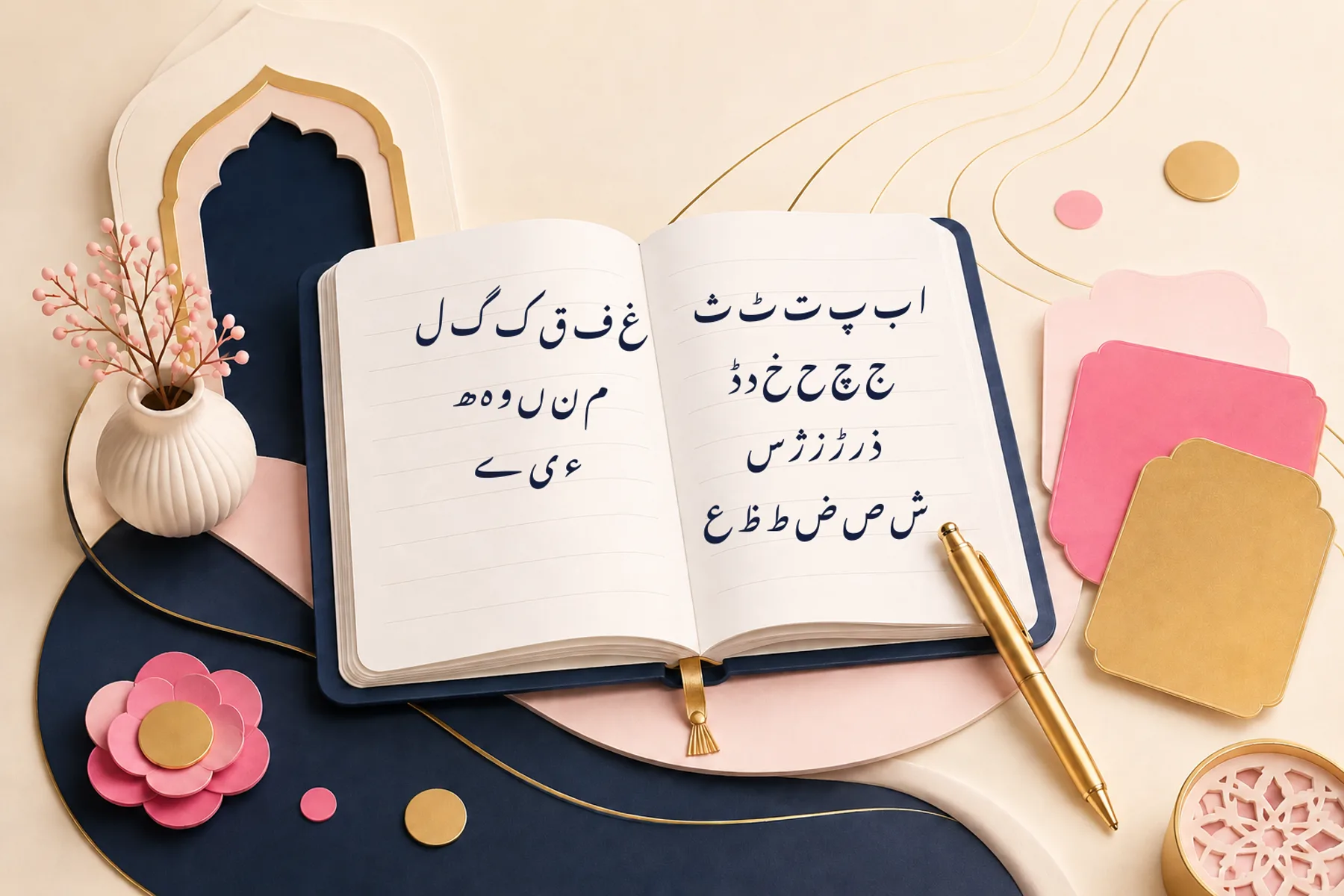
Shahmukhi is the right-to-left Perso-Arabic writing system widely used for Punjabi in Pakistan. It shares many letter shapes with Urdu, but Punjabi sound needs and spelling practices shape how the script is used. Learners who already read Urdu may recognise much of the system, while complete beginners can still learn it through a careful sequence.
There is no benefit in rushing through one long alphabet line. Shahmukhi letters change their visual form according to position, and some letters connect differently from others. A practical learner therefore studies shape families, dots, joining behaviour and sound together.
Shahmukhi uses a Perso-Arabic base with letters needed for Punjabi sounds. Alphabet counts can differ depending on whether a chart separates contextual forms or includes additional letters used in loanwords. For beginners, it is more useful to recognise the common working inventory below than to argue over one fixed number.
Many letters share the same underlying body and are distinguished by the number or position of dots. Grouping them reduces the number of completely new shapes your brain must store. Say the sound while pointing to the dots so shape and sound are learned together.
Compare the same basic body and track exactly where the dots sit. Write the base once, then add the correct dot pattern.
Keep the body stable and use the dots to identify the letter. Read shuffled cards so you do not depend on memorised order.
These letters do not connect to the following letter on their left. This creates a visible break inside some words.
Practise the full body and dot placement slowly. Do not make the letters tiny before the proportions are familiar.
These letters appear frequently in connected writing. Learn isolated and joined forms side by side instead of treating them as different alphabets.
Writing moves from right to left, but letters within a word do not all behave identically. Most connect to the letter before and after them, changing shape according to whether they are isolated, initial, medial or final. A smaller group connects only on one side, creating a break before the next letter.
Use a four-box card for each joining letter: isolated, beginning, middle and end. Trace the connection line in a contrasting pencil colour. For non-joining-after letters, leave a deliberate gap before the next character. This turns joining into a visible rule rather than a guessing exercise.
Long vowels are commonly represented with letters, while short vowels may be shown with diacritical marks but are often omitted in ordinary fluent writing. This means beginners must gradually learn to recognise familiar word patterns rather than expecting every spoken vowel to appear as a full letter.
At the start, practise fully marked teacher-approved examples so sound and spelling stay connected. Later, compare the same word with fewer marks and use sentence context to read it. Learners who speak Punjabi already often progress quickly once common word shapes become familiar.
A private lesson can connect the script to Pakistani Punjabi, family vocabulary and the words you actually want to read and write.
Explore one-to-one Punjabi lessonsPractise right-to-left movement and two shape families. Say the sound and count the dots every time.
Add several common joining letters and the non-joining-after group. Compare isolated and joined forms.
Use a small set of fully checked examples. Point to long-vowel letters and short-vowel marks before reading aloud.
Read shuffled letters, copy several joined forms and write ten characters from memory. Review only the uncertain group first next week.
No. The writing systems are closely related and share many letters, so Urdu literacy is a strong advantage. Shahmukhi is used to write Punjabi, whose vocabulary, grammar, pronunciation and some letter needs differ from Urdu.
No. Speaking and listening can be learned through Roman Punjabi and guided conversation. Shahmukhi becomes important when you want to read Pakistani Punjabi writing, communicate in the script or build fuller literacy.
Choose according to your family, location, reading material and goals. Shahmukhi often fits learners connected to Pakistan, while Gurmukhi often fits learners reading Punjabi from India. Some heritage learners eventually study both. You can also read the guide on whether to prioritise speaking or reading.
Build a clear reading pathway with patient correction, useful family vocabulary and practice matched to your level.
Choose your Punjabi lesson