Pakistani Punjabi and Urdu are related but distinct languages. Shared words and similar-looking writing can make parts of a conversation familiar, yet Punjabi has its own everyday vocabulary, grammatical forms and sound patterns. Choose your first learning priority around the people and situations that matter to you, rather than assuming that learning one language automatically gives you the other. [1] [2]
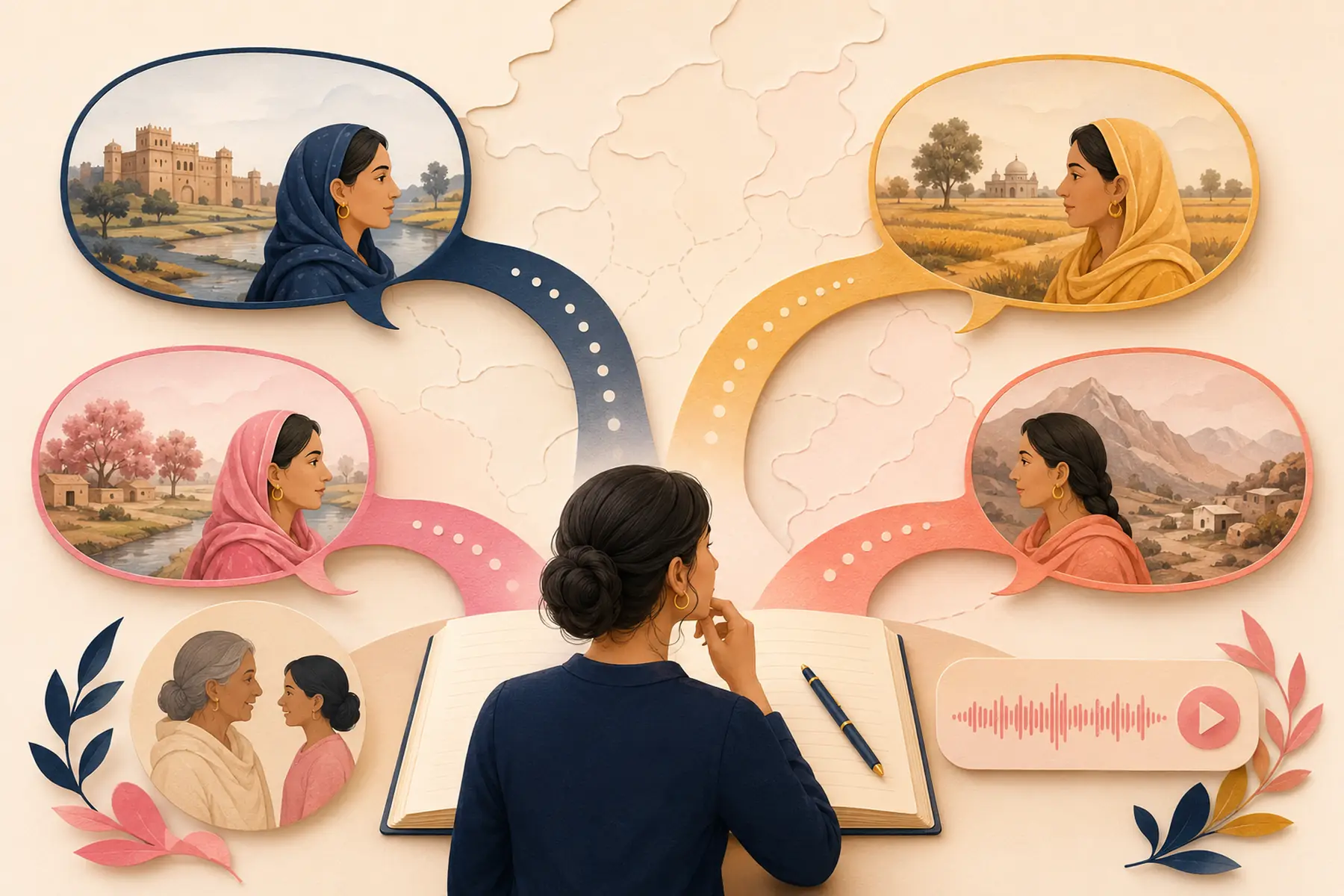
You may hear Punjabi during a family visit, Urdu in a television programme and a mixture of both during a phone call. That can leave you wondering what you should actually study. Perhaps you already understand some Urdu but cannot follow your grandparents’ Punjabi. Perhaps your partner calls the family’s language “Punjabi”, while the messages they send look like the Urdu you have started reading.
The useful question is not which language is better. It is which conversations you want to join and what you can already do. This guide separates language, script and family usage, then gives you a practical way to choose a starting point. The paired examples are learning illustrations, not a claim that every Pakistani family uses the same wording.
Are Punjabi and Urdu the same language?
No. Both belong to the Indo-Aryan branch of the Indo-European language family, but they are studied and described as distinct languages. Punjabi is associated with Punjab on both sides of the India–Pakistan border. Urdu has a wider role as a language of communication across Pakistan as well as its own communities and traditions. [1] [2]
“Pakistani Punjabi” is useful when discussing the Punjabi a learner encounters in Pakistan, but it does not identify one identical accent or family vocabulary. Ask for more detail: which relatives, which places, which recordings and which situations? These answers are more useful for lesson planning than expecting a national label to describe every speaker. Regional variety is part of the picture. [3]
| Question | Pakistani Punjabi | Urdu |
|---|---|---|
| What is the language? | Punjabi, with regional spoken varieties | A distinct, related Indo-Aryan language |
| What writing will I meet? | Shahmukhi in Pakistani Punjabi texts | A Perso-Arabic script, commonly in Nastaliq style |
| What should I listen for? | Punjabi words, endings and the target speaker’s sound patterns | Urdu words and grammatical forms, not just familiar shared words |
| How should I choose? | Prioritise it for the Punjabi conversations you want to join | Prioritise it for the Urdu conversations and materials you want to use |
The language-family and writing-system distinctions above are described by the University of Pennsylvania’s Punjabi and Urdu programmes. [1] [2] The learning priorities are a decision framework, not a universal rule.
What can knowledge of Urdu help you recognise?
Related words can give you footholds. For example, everyday forms such as paani, “water”, and ghar, “home/house”, occur in both languages. Familiarity with these items can help you identify what a conversation concerns, but it does not tell you the meaning of every word around them. Use shared vocabulary as something to investigate, not proof that you understood the entire sentence.
Make a small comparison page for material you actually hear. Put the meaning in the first column, the Punjabi expression in the second and the Urdu expression in the third. Ask a speaker who knows both languages to check the completed expressions, including pronunciation. Keep “I recognise this” separate from “I can use this accurately in a reply”.
You can also reuse helpful study habits. Knowing how to listen for a verb ending, ask about a noun’s gender or work through a right-to-left text gives you questions to ask about new material. It does not remove the need to learn the answers for Punjabi. Treat your earlier learning as a toolkit rather than a completed Punjabi course.
What differences will you notice in everyday speech?
Short exchanges show why a conversation can feel familiar without being identical. Read the meaning first, then compare each complete phrase. The Punjabi forms below illustrate common Pakistani conversational choices. Roman spelling is not a pronunciation standard, and another household may prefer a different form.
| Meaning | Punjabi: Roman and Shahmukhi | Urdu: Roman and Urdu script |
|---|---|---|
| What? | ki کی | kya کیا |
| In the house | ghar vich گھر وچ | ghar mein گھر میں |
| Your name, respectful | tuhada naa تہاڈا ناں | aap ka naam آپ کا نام |
Punjabi University’s teaching materials document Punjabi interrogatives, possessive forms and postpositions. The Hindi Urdu Flagship provides further Urdu learning materials for comparison. [4] [5] [6] The table is a small practice set, not a conversion formula between the languages.
Small grammatical words deserve their own practice
In the house example, ghar is familiar in both columns, while the relationship word changes. That is a useful warning against learning nouns alone. Practise the whole location phrase. Ask where an object is, answer with the phrase in a checked sentence, then move the object and repeat the task.
The respectful name phrase offers a second comparison. Do not replace an Urdu pronoun and assume the remaining words can stay untouched. Record the Punjabi phrase as a unit, learn what relationship it suits, and practise the question it belongs to. A small number of dependable phrases is a more practical starting goal than attempting instant word-by-word conversion.
Punjabi pronunciation needs direct listening
Punjabi has lexical tone: pitch can help distinguish words. Research on Lyallpuri Punjabi describes tone alongside consonant and vowel contrasts. [7] For a learner coming from Urdu, the practical task is to listen to Punjabi itself rather than silently reading every familiar-looking spelling through an Urdu pronunciation model.
Choose a short recording from the variety you want to understand. Listen for the whole expression, record your attempt, then ask for feedback on one difference. Avoid imitating a comic “Punjabi accent”. The Punjabi pronunciation guide can help you identify specific features to practise.
Is Shahmukhi just Urdu writing with a different name?
Shahmukhi is a writing system used for Punjabi, while Urdu also uses a Perso-Arabic writing system. Similar letter shapes do not make the languages identical. The word “Nastaliq” refers to a calligraphic style, not a third spoken language. Keep the identity of the language separate from how its text looks. [1] [2]
A concrete example comes from Sanjh, which publishes matching Punjabi content in Shahmukhi and Gurmukhi editions. The writing changes while the language remains Punjabi. [8] For your own study, compare one short Punjabi line with its meaning and a recording. Do not guess that a text is Urdu solely because you recognise its script.
Someone who already reads Urdu can begin by checking what transfers to a particular Shahmukhi text and what still feels unfamiliar. Someone whose immediate aim is speaking to relatives can practise conversation while deciding whether reading is also useful. The Shahmukhi beginner guide is the separate next step for letter shapes and joining practice.
Why do families mix Punjabi, Urdu and English?
Language switching can be part of multilingual conversation, not evidence that the speakers cannot distinguish their languages. A published case study of two brothers examined Punjabi, Urdu and English switching in their conversations. Its findings describe those speakers, not every family. [9]
For a learner, the important question is what happens in the household you want to speak with. Does one relative usually answer in Punjabi? Does another prefer Urdu? Which language appears when the topic changes? Ask without turning the conversation into a test of anyone’s identity or fluency.
Try keeping a brief language map after a call. Record the person, situation and language you think you heard, then ask someone to check it. Mark uncertain parts as uncertain. A relative’s ability to switch into Urdu to help you is useful support, but it does not show that you understood their original Punjabi sentence.
Should you learn Punjabi or Urdu first?
Choose the first language around a concrete task. “Have a five-minute Punjabi conversation with my grandmother” and “follow an Urdu programme without translating every sentence” lead to different practice. Neither goal needs to justify itself by being more practical or more authentic than the other.
For a Punjabi-speaking family, start with the Punjabi those relatives actually use. Ask for a few short expressions, identify the variety where possible, and practise replies. For Urdu-speaking contacts, make Urdu your first conversational target. For mixed-language households, choose one clearly defined situation for each language instead of switching your study plan every day.
Already knowing some Urdu is not a reason to avoid Punjabi. Equally, choosing Punjabi for a personal connection does not commit you to learning every related language. Use the guide to choosing a Punjabi variety when the next question is which Punjabi to focus on.
A small exercise to choose your next lesson
Complete the table below before selecting new resources. Use real people and situations rather than assumptions about a whole country. You do not need to record private conversations: a few voluntary sample phrases from a willing speaker are enough to start a discussion with a tutor.
| Question | Your note |
|---|---|
| Who do I most want to speak with? | Choose one person or group |
| Which language do they prefer with me? | Ask them rather than guessing |
| What can I already understand? | List two specific situations |
| What reply would I like to give? | Write its meaning in English |
| Do I need reading for this goal? | Conversation, messages, books or a combination |
Your next step should follow the answers. For a Punjabi goal, bring the sheet to a private Punjabi lesson with Komal. Explain any Urdu knowledge you already have, but also identify the Punjabi conversation you cannot yet manage. That gives the lesson a clearer focus than simply asking to “learn both”.
Sources and language notes
The comparisons are illustrative and require the same attention to variety as any beginner phrase set. No audio recording is supplied or claimed.
- University of Pennsylvania: The Punjabi Language.
- University of Pennsylvania: The Urdu Language.
- Columbia University: Introduction to Punjabi, regional variety.
- Punjabi University: pronouns.
- Punjabi University: postpositions.
- University of Texas at Austin, Hindi Urdu Flagship: learning and teaching resources.
- Journal of the International Phonetic Association: Punjabi (Lyallpuri variety).
- Sanjh: matching Punjabi editions in Shahmukhi and Gurmukhi.
- Qasim and Qasim: A Case Study of Code Switching in Trilingual Conversations.