Respectful Punjabi involves more than adding ji. Choose a pronoun that suits the relationship, keep its verb form consistent, use the person's preferred name or title and pay attention to the request itself. For an unfamiliar adult, tusi is a useful respectful starting form. A familiar tu can belong in close relationships, but it is not a form to apply to everyone indiscriminately.
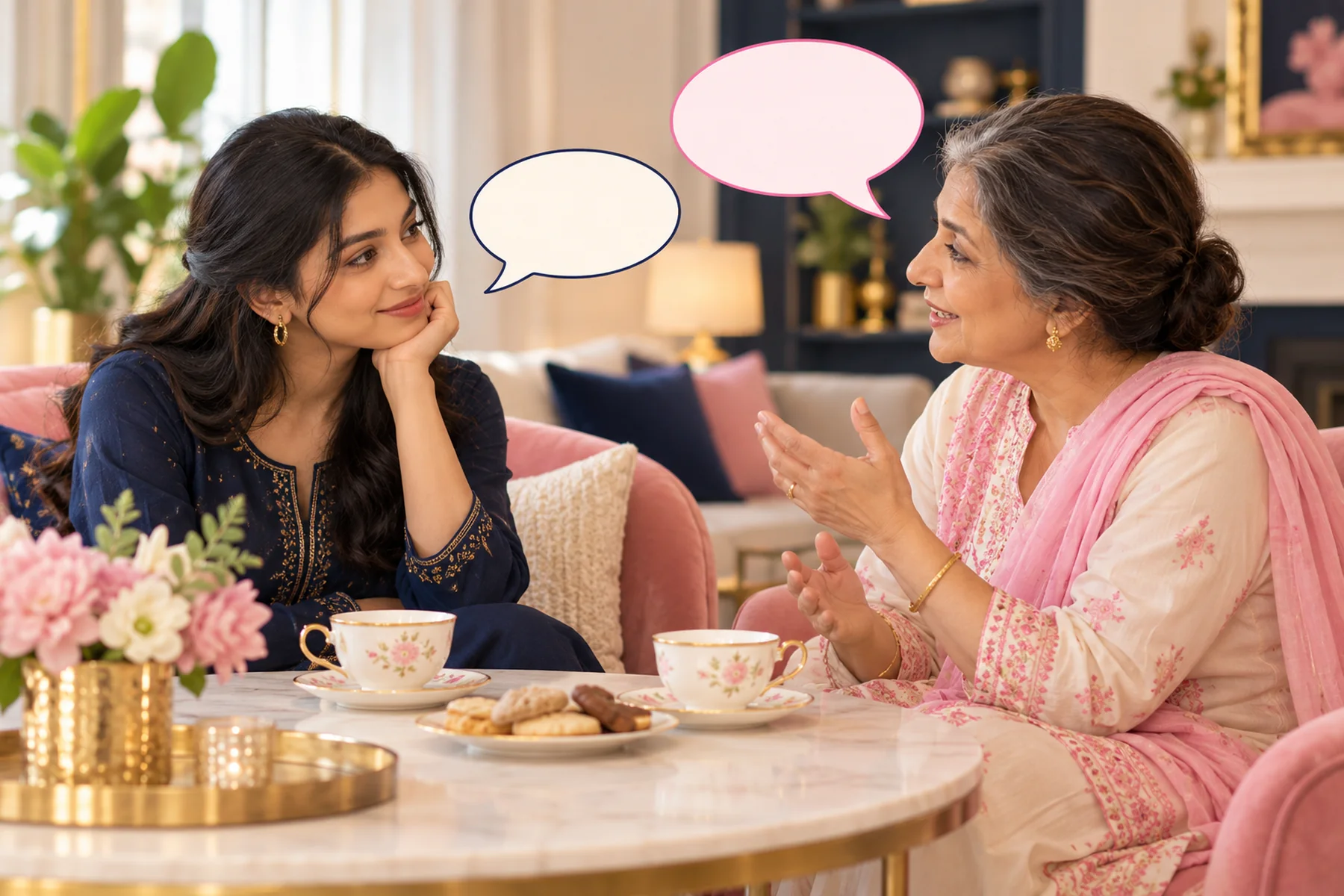
A beginner may hear a family member use an intimate form and wonder whether to copy it with a new acquaintance. Another learner may add ji repeatedly while keeping a very abrupt request. The practical solution is to learn complete exchanges in context, rather than treating one word as a universal politeness switch.
This guide focuses on choices in conversation. It is not a full pronoun grammar reference, a rulebook for every Punjabi household or a claim that age alone determines how people must speak. Use the scenarios to identify what to check with the person you are addressing, then practise a complete model.
Tusi and tu: learn the relationship and the sentence together
Punjabi distinguishes singular and plural personal pronouns, with related forms used in different grammatical roles. Punjabi University's pronoun reference sets out those forms. [1] In respectful conversation, the plural form tusi can address one person. The site's self-introduction guide uses it for meeting someone new.
Do not change only the pronoun in a memorised sentence and assume the remaining words will stay the same. Compare the two location questions below. The first is a familiar singular model; the second is a plural or respectful model. Practise the second when you are unsure of an appropriate starting form, then ask how the person prefers to be addressed.
| Context | Roman Punjabi | Gurmukhi | Shahmukhi |
|---|---|---|---|
| Familiar singular: Where are you? | Tu kithe hain? | ਤੂੰ ਕਿੱਥੇ ਹੈਂ? | توں کتھے ہَیں؟ |
| Respectful or plural: Where are you? | Tusi kithe ho? | ਤੁਸੀਂ ਕਿੱਥੇ ਹੋ? | تسیں کتھے ہو؟ |
These are reference models, not a claim that every region uses identical endings. You may hear an alternative form within a family variety. Keep that whole version in a separate note and ask about its setting. Calling a regional alternative wrong before checking it confuses a difference in usage with a grammatical mistake.
Do not assume that a relative's use of tu gives every visitor permission to use it. The speakers may have a close relationship with established habits. Equally, do not label every intimate use as insulting. Listen to who is speaking to whom, and distinguish that relationship from the one you have with the same person.
What does ji add?
Ji can accompany a name, title, greeting or response as a respectful form of address. For example, the existing greeting model Sat Sri Akal ji adds it to the opening. The word is useful, but it does not replace suitable wording or considerate delivery. A demanding request with ji attached may still be unwelcome.
Haan ji.
ਹਾਂ ਜੀ।
ہاں جی۔
Yes, with respectful address. Its exact force depends on the conversation.
Practise saying the response at an ordinary pace, then leave room for the other person. Avoid adding ji after every word because you are worried that one occurrence is insufficient. Keep a complete model from a trusted speaker and notice how it is delivered in context.
For a useful comparison exercise, take one request from your notes and explain the situation in English. Ask a teacher how they would make the whole request appropriate, not simply where to insert ji. You may need a different verb form, a reason, a softer opening or no change at all. The answer should follow the setting.
Family titles identify relationships, not just age
Some Punjabi family terms make distinctions that English “uncle” or “aunt” leaves unspecified. Common examples include mama for a mother's brother, chacha for a father's younger brother and taya for a father's elder brother. The educator-produced family reference linked below illustrates those relationships. [2] This small set is not a replacement for a complete kinship guide.
A relationship label does not automatically tell you the preferred form of direct address. A household may use a title, a name, an affectionate form or a combination. Ask what the person is normally called and what they would like you to use. Do not invent a kinship relationship merely because someone is older than you.
| Person | Relationship | Preferred address | Checked with |
|---|---|---|---|
| Write the person's name | Describe the relationship precisely | Record the complete title or name | The person or someone who knows the household |
| A new teacher | Teacher, not assumed relative | Ask their preferred name or title | The teacher |
| A family friend | Friend of the family | Do not assume a particular kinship term | The friend or host |
Keep the address book private and practical. It does not need ages, personal histories or a public family tree. Its purpose is to stop you guessing during an introduction. Record a corrected preference once and use it consistently rather than repeatedly asking the same person to explain.
Choose your wording by situation
Before speaking, consider whether you are meeting someone for the first time, speaking with a familiar person or addressing a group. Then ask what the sentence is doing: requesting help, confirming information, disagreeing or offering something. Respectful address and the purpose of the request both matter.
| Situation | A sensible starting choice | What still needs checking |
|---|---|---|
| Meeting an unfamiliar adult | A respectful tusi model and preferred name | The greeting and purpose of the question |
| Speaking with an elder relative | The household's established respectful address | Whether a personal topic is welcome |
| Talking with a close friend | The form both people normally use | Do not copy it automatically with strangers |
| Addressing several people | A plural form with matching grammar | Whether you mean the whole group |
| Asking for a favour | A suitable complete request | Leave room for refusal; ji is not pressure |
The table is an original decision aid, not a universal cultural ranking. A respectful interaction does not require you to adopt an unfamiliar household rule without understanding it. Ask for clarification, notice preferences and keep the intended meaning clear.
Tone, timing and listening are part of the exchange
Use a normal, unhurried delivery rather than exaggerating politeness into a performance. Give the person time to answer. A suitable pronoun does not compensate for repeatedly interrupting, ignoring a refusal or asking an intrusive question. Practise the pause after your sentence as deliberately as the sentence itself.
When you disagree, explain the situation you want to express and ask for a natural Punjabi model. Do not build a forceful English sentence word by word and hope that a respectful title will soften it. The best beginner practice uses a small, ordinary disagreement, such as choosing a meeting time, rather than a sensitive family dispute.
For a first family visit, use the visit phrase guide to rehearse openings, responses and endings together. The same words may feel different when they are part of a thoughtful exchange rather than isolated items on a list.
How to recover after using an unsuitable form
Make a brief correction, use the preferred form and continue. You do not need to give a long explanation of why you made the mistake. Ask how the person would like to be addressed when the preference is unclear, then update your notes after the conversation.
If you are practising with a teacher, ask them to contrast the two complete versions. Identify which part changed and say the intended version in another short exchange. Do not simply repeat the corrected pronoun while leaving the rest of the sentence untouched. The useful unit is the whole question or request.
A correction should help the next interaction, not become a label attached to the learner. Keep the note specific: “Use this title with this person” or “Keep ho with this tusi frame.” Avoid broad rules such as “everyone older must always be called the same thing,” which hide the context you actually needed to learn.
Try a three-scenario rehearsal
Write three situations: meeting a new teacher, speaking with a familiar relative and asking a group where to sit. For each, choose the person you are addressing, their preferred title and one complete question. Practise the question, a possible reply and a brief follow-up. Have a fluent speaker check the finished exchange rather than individual words in isolation.
Next, change the relationship while keeping the meaning similar. Explain which wording you would reconsider and why. There may be more than one appropriate answer, so the aim is to notice the decision rather than memorise a single formula. Mark uncertainty instead of presenting an unverified guess as a rule.
Bring your three scenarios to a Punjabi lesson with Komal. Work with the variety and relationships relevant to your life, and keep the resulting models together with their context. Respect becomes easier to practise when it is attached to real people and complete exchanges, not a growing list of disconnected honorifics.
Sources and scope
Examples are constructed learning models. The decision table is not a complete grammar reference or a claim about every family's preferences.
- Punjabi University: personal pronoun forms.
- Maastarji: Punjabi family relationship vocabulary, selected kinship terms.